Not Every Receding Hairline Is Pattern Loss: Five Scalp Conditions That Can Mimic Androgenetic Alopecia

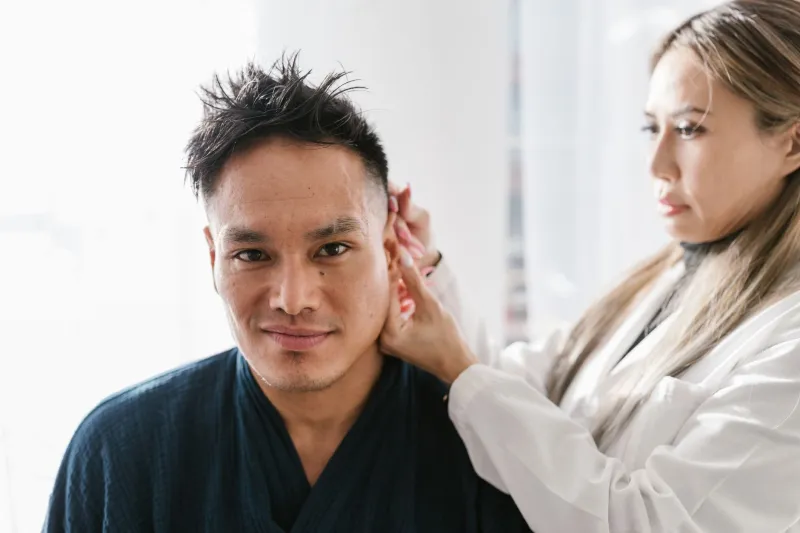
Photo: dermatologist examining man's scalp with dermatoscope in clinic, via c8.alamy.com
Few dermatologic complaints invite self-diagnosis as readily as hair loss. The pattern is familiar, the photographs are easy to compare, and the treatments are a search away. Yet the single most consequential step in any hair loss regimen happens before a prescription is written: confirming what, precisely, is being treated.
Androgenetic alopecia — male pattern baldness — is by far the most common cause of hair loss in men, and its signature is fairly consistent: gradual miniaturization of follicles in the temples, frontal hairline, and vertex, driven by inherited sensitivity to dihydrotestosterone (DHT). But it is not the only condition that produces visible thinning, and several look-alikes either resolve without medication or require an entirely different clinical approach.
Why the Distinction Matters
Finasteride and minoxidil are effective within their indications and essentially inert outside them. A man shedding diffusely after a high fever, a crash diet, or a severe illness will not regrow hair faster because he added a DHT blocker. Likewise, a scarring condition left unrecognized can progress to permanent follicular loss while the patient assumes he is simply losing the genetic lottery.
Misdiagnosis also carries an opportunity cost that is easy to underestimate. Pattern hair loss responds best when treatment begins early; months spent on the wrong therapy are months of continued miniaturization. That is why a short pause before ordering — long enough to confirm the diagnosis — is usually time well spent.
1. Telogen Effluvium: The Diffuse Shed
Telogen effluvium presents as a generalized increase in shedding rather than a patterned recession. Patients typically notice more hair on the pillow, in the shower drain, or on a comb, often two to three months after a recognizable trigger: major surgery, a severe infection, high fever, rapid weight loss, childbirth (in women), certain medications, or intense psychological stress.
The key distinction is distribution. Telogen effluvium thins broadly across the scalp rather than concentrating at the temples and crown, and a gentle hair-pull test often yields several loose hairs. Most acute episodes resolve within six months once the trigger is removed. When shedding persists beyond that window, clinicians look for an ongoing cause — thyroid dysfunction, iron deficiency, or a chronic illness — and also consider whether an underlying androgenetic process has been unmasked.
2. Alopecia Areata: The Smooth Patch
Alopecia areata is an autoimmune condition in which the immune system targets hair follicles, producing one or more sharply demarcated, completely smooth bald patches. The scalp may look entirely normal around the patch, and short, tapered “exclamation point” hairs are sometimes visible at the margins. Nail pitting or ridging can accompany it.
Severity ranges from a single small patch that resolves spontaneously to extensive involvement of the scalp or body. Because the mechanism is immunologic rather than hormonal, finasteride has no role in its treatment. Management typically involves a dermatologist and may include topical or intralesional corticosteroids or, in more extensive disease, newer immunomodulating therapies.
3. Seborrheic Dermatitis: The Flaking Scalp
Seborrheic dermatitis produces greasy scaling, redness, and itching along the hairline, behind the ears, and in the eyebrows. It does not usually cause permanent hair loss on its own, but chronic inflammation and repeated scratching can aggravate shedding, and the two conditions frequently coexist: many men with androgenetic alopecia also have an oily, flaky scalp.
Treatment is straightforward and typically involves medicated shampoos containing ketoconazole, zinc pyrithione, coal tar, or salicylic acid, used on a maintenance schedule rather than as a one-time course. Distinguishing seborrheic dermatitis matters because a flaking scalp can make hair appear thinner than it is, and because uncontrolled inflammation complicates the assessment of any concurrent pattern loss.
4. Traction Alopecia: The Mechanical Cause
Traction alopecia results from sustained tension on the hair — tight ponytails, braids, cornrows, weaves, or prolonged use of snug headwear. It most often affects the hairline and temples, and early on the loss is reversible: follicles are inflamed but not destroyed. Over years, repeated tension can produce permanent follicular dropout and scarring.
The remedy is largely behavioral. Loosening styles, alternating partings, avoiding tension at the margins, and giving the hairline extended breaks from styling will often allow regrowth if the process is caught early. Men with longer hair, athletes who wear tight headgear, and anyone with a persistently tender scalp should consider this diagnosis seriously.
5. Thyroid and Nutrient-Related Shedding
Both hypothyroidism and hyperthyroidism can cause diffuse thinning, often accompanied by coarser or drier hair and by systemic symptoms such as fatigue, weight change, cold or heat intolerance, or changes in heart rate. Nutritional deficiencies behave similarly: low iron stores, inadequate protein intake, zinc deficiency, low vitamin D, and vitamin B12 deficiency are all associated with increased shedding, as is rapid weight loss from restrictive dieting.
These causes are identified through laboratory testing rather than observation alone. A reasonable workup for unexplained diffuse shedding includes thyroid-stimulating hormone, a complete blood count, ferritin, and selected vitamin levels, ordered at the discretion of a clinician. Correcting the underlying deficiency or thyroid abnormality usually reverses the shedding — and no amount of topical minoxidil substitutes for that correction.
Signals That Should Pause an Order
Certain features argue strongly for an in-person or video evaluation before treatment begins:
- Patches of complete, smooth hair loss rather than diffuse thinning
- Scalp pain, burning, itching, or visible redness and scaling
- Loss of eyebrows, eyelashes, or body hair
- Rapid, widespread shedding rather than gradual patterned change
- Scarring, shiny skin, or visible loss of follicular openings
- Fatigue, weight change, or other systemic symptoms alongside hair loss
- A family history with no pattern loss, or an atypical distribution
Anyone in these categories should photograph the scalp, note the timeline, and seek a diagnosis before committing to a prescription. For men whose loss is patterned, gradual, and consistent with a family history, androgenetic alopecia remains the most likely explanation — and treatment can proceed with confidence once that has been reasonably established.
What a Confirmed Diagnosis Changes
A confirmed diagnosis does not delay good treatment; it directs it. For genuine pattern hair loss, the evidence-based mainstays remain a 5-alpha reductase inhibitor such as finasteride and a topical vasodilator such as minoxidil, ideally begun early and continued consistently. For the look-alikes described above, the correct intervention ranges from a medicated shampoo to a laboratory panel to a referral — none of which a pharmacy can supply in place of a diagnosis.
The practical takeaway is modest but important: order the right treatment, not merely a treatment. A few weeks spent confirming the cause is a small price for avoiding months spent on the wrong one.